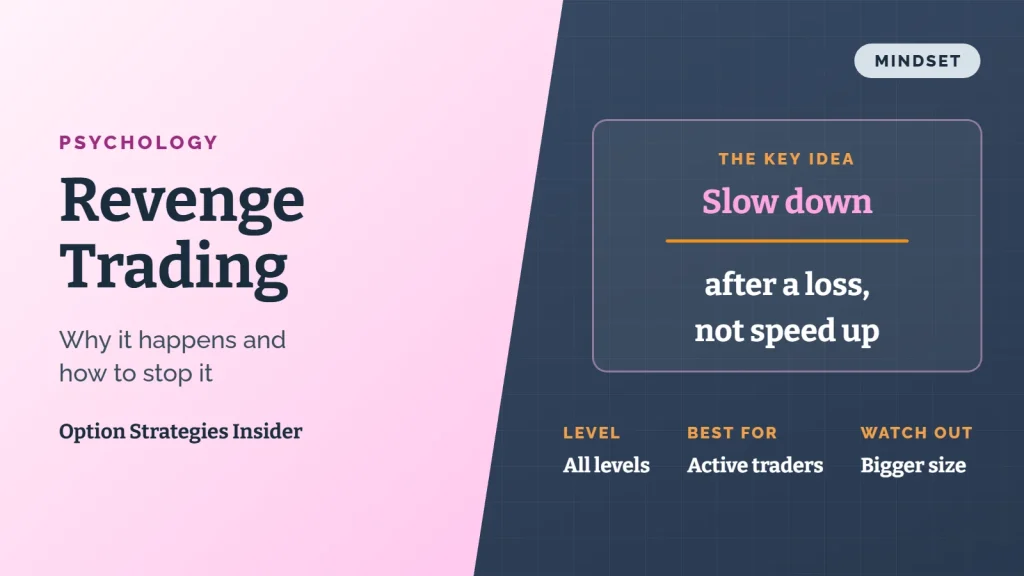
Revenge trading is the urge to win back a loss right away with a bigger, faster trade. It feels like taking control. In reality it is the moment most traders lose control, because the next trade is driven by the last loss instead of by a real setup.
Almost every active trader has done it at least once. You take a loss, it stings, and within minutes you are back in the market with double the size, a shorter expiration or a stock you never planned to trade. Sometimes it works. More often it turns a normal losing trade into a bad day, and a bad day into a damaged account.
Here is why revenge trading happens, how to spot it early and the simple rules that stop it before it costs you real money.
What Revenge Trading Looks Like
Say you buy calls on a stock heading into the open. It gaps the wrong way and you close the trade down $800. You are annoyed, and you want that $800 back before lunch.
So you buy more contracts on a different stock, this time with a closer expiration because it moves faster. You skip your usual checklist. You tell yourself you will be out quickly. When it goes against you too, you hold, because closing would mean taking two losses in one morning.
That is revenge trading. The second trade was not based on a setup. It was based on the first loss.
Each pass through this loop usually comes with bigger size and less planning, which is why the losses tend to grow. The rules on the left are covered in detail below.
Why It Happens
Losses hurt more than gains feel good
Behavioral finance research has shown for decades that people feel losses more strongly than gains of the same size. In their 1992 work on prospect theory, Amos Tversky and Daniel Kahneman estimated that a loss carries roughly 2.25 times the emotional weight of an equal gain. A 2024 review of 150 studies put the average closer to 2 times. Either way, an $800 loss feels much bigger than an $800 win, and that pain pushes you to make it go away fast.
We cover this bias in more depth in our guide to loss aversion in trading.
The need to be right
A loss can feel personal, like the market proved you wrong. Revenge trading is often an attempt to prove the market wrong instead. But the market does not know you took a loss, and it does not owe you anything back.
Anchoring to the account balance
Many traders anchor to where their account was this morning. Once it drops below that number, every decision becomes about getting back to even. That makes the next trade about the account balance, not about whether the setup is any good.
Why It Is Even More Dangerous With Options
Revenge trading hurts in any market, but options make it worse for a few reasons:
- Leverage cuts both ways. A small move in the stock can mean a large percentage loss on the option, so doubling your size doubles a risk that was already magnified.
- Time is working against you. When you rush into a short-dated option to make money back fast, time decay starts eating your premium the moment you buy. Holding and hoping costs you every hour.
- Wide bid-ask spreads. Jumping in and out quickly on less liquid contracts means giving up a bit of the spread every time.
- Volatility is already priced in. After a big move, implied volatility is often elevated, so the replacement trade can cost more than it looks.
Warning Signs You Are About to Revenge Trade
The hardest part is noticing it in the moment. Watch for these signs:
- You are entering a new trade within minutes of closing a loser.
- Your position size is bigger than normal “just this once.”
- You are trading a stock or strategy that was not on your watch list this morning.
- You skipped your entry checklist or did not set an exit.
- You are thinking about the dollar amount you need to make back instead of the setup.
- You feel angry, rushed or restless.
If two or more of these are true, stop. The trade can wait. A good setup will still be a good setup in an hour.
How to Stop Revenge Trading
1. Set a daily max loss and honor it
Decide in advance how much you are willing to lose in a single day, such as 1% to 2% of your account. When you hit it, you are done for the day. No exceptions. This one rule caps the damage revenge trading can do, because it takes the decision out of your hands when your judgment is worst.
2. Keep your position size fixed
Use the same size rules after a loss that you use after a win. Better yet, cut your size in half after two losers in a row. The goal after a loss is to slow down, not speed up.
3. Add a cooling off period
After any loss above a set amount, step away from the screen for at least 15 to 30 minutes. Take a walk. Your heart rate and your judgment both come back to normal faster than you think.
4. Ask one question before every trade
“Would I take this exact trade if my last trade had been a winner?” If the honest answer is no, it is a revenge trade. Skip it.
5. Use a written checklist
Write down what a valid setup looks like for you: trend, entry trigger, exit plan, position size and max risk. If a trade does not check every box, it does not get placed. Our 5 steps to a high trading win rate is a good place to start building one.
6. Prefer defined risk
When you do trade after a loss, use strategies with a known max loss, like debit spreads or credit spreads, instead of naked options. If emotions take over, at least the worst case is set in advance.
7. Keep a trading journal
Log every trade, including how you felt when you placed it. After a few weeks, patterns jump out. Many traders find that their worst losses come right after another loss, which is exactly the proof you need to take the rules above seriously.
What to Do Right After a Big Loss
- Close the platform or switch to a view without the order ticket.
- Write down what happened and whether you followed your plan.
- If you broke a rule, write down which one and why.
- Do not place another trade until you have done steps 1 through 3 and your daily max loss still allows it.
- Remember the bigger picture: one loss is one trade, not a verdict on you as a trader.
The Bottom Line
Losses are part of trading. Even the best traders lose on a large share of their trades. What separates them is that a loss does not change how they trade next. They stick to their size, their setups and their exits no matter how the last trade went.
If you can make that shift, you will remove one of the most common and most expensive mistakes in trading. For more on building that kind of discipline, read 5 qualities of successful options traders and 9 common mistakes to avoid when trading options.
Frequently Asked Questions
Is revenge trading the same as overtrading?
They are related but not the same. Overtrading is placing too many trades in general. Revenge trading is a specific kind of overtrading that happens right after a loss, usually with bigger size and less planning.
How do I know if a trade is revenge or a real setup?
Ask whether you would take the trade if your last trade had been a winner, and whether it meets every item on your written checklist. If either answer is no, treat it as revenge.
Should I stop trading for the day after a loss?
Not after every loss. But you should stop once you hit your preset daily max loss, and it is smart to take a short break after any loss that leaves you feeling angry or rushed.