A bull call spread is a simple way to bet on a stock going up while keeping your cost and risk low. You buy a call and sell a higher strike call with the same expiration. The call you sell lowers the price of the trade, and in exchange your profit is capped at the higher strike.
Because you pay to open it, the bull call spread is a debit spread, and you’ll also hear it called a bull spread or a call debit spread. It’s one of the most popular bullish option strategies for traders who have a price target in mind.
How the Bull Call Spread Works
- Buy 1 call at strike A, usually at or near the money
- Sell 1 call at strike B, a higher strike, with the same expiration
Your max loss is what you pay. Your max profit is the distance between the strikes minus what you paid. That makes it cheaper and less risky than buying a long call on its own, as long as you don’t need the stock to run past strike B.
Payoff Diagram
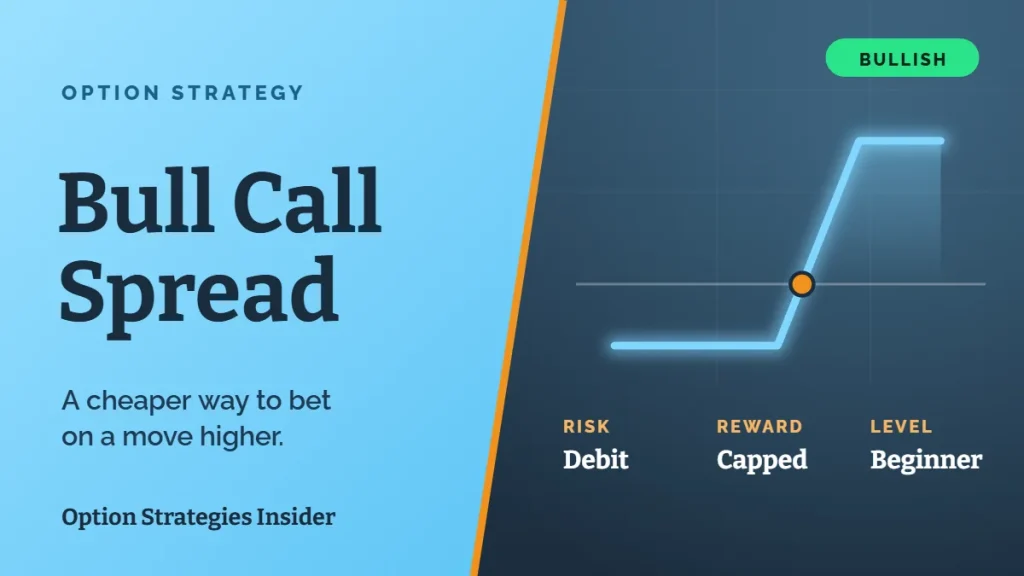
The diagram is flat below strike A at your max loss, rises between the strikes, then flattens again above strike B at your max profit.
Max Profit, Max Loss and Breakeven
- Max profit: strike B minus strike A, minus the debit paid.
- Max loss: the debit paid.
- Breakeven: strike A plus the debit paid.
Bull Call Spread Example
XYZ trades at $100 and you think it can reach $110 over the next two months. You buy the 100 call for $4.00 and sell the 110 call for $1.50, for a net debit of $2.50, or $250. Your breakeven is $102.50. At expiration:
- XYZ at $110 or higher: the spread is worth its full $10. You make $7.50 a share, or $750, three times what you risked.
- XYZ at $106: the 100 call is worth $6 and the 110 call expires worthless, so you make $3.50 a share, or $350.
- XYZ at $100 or lower: both calls expire worthless and you lose the $250 debit, and nothing more.
Compare that to buying the 100 call alone for $4.00. Your breakeven would be $104 instead of $102.50, and you’d risk $400 instead of $250.
When to Use a Bull Call Spread
- You’re moderately bullish and have a realistic price target.
- Calls look expensive because implied volatility is high, so selling a call helps offset the cost. Learn more about implied volatility.
- You want a defined, limited risk on a bullish trade.
Adjusting the Trade
If the stock moves your way early, many traders take profits once the spread is worth 50% to 75% of its max value instead of waiting for expiration. If the stock blows past strike B, you can close the spread and open a new one at higher strikes to stay in the move. If the trade goes against you, the most you can lose is the debit, so there’s no need to panic, but closing early can save whatever value is left.
Bull Call Spread vs. Bull Call Ratio Spread
A bull call ratio spread buys 1 call and sells 2 or more higher strike calls. It can be opened for little or no cost, but selling more calls than you own leaves you with unlimited risk if the stock rallies far past the short strike. The standard bull call spread on this page keeps your risk limited to the debit.
Bull Call Spread vs. Bull Put Spread
Both are bullish with defined risk. A bull put spread is a credit spread, so you collect money up front and profit if the stock stays above the short put. The bull call spread is a debit spread that needs the stock to rise above your breakeven. You can read more about credit spreads in how credit spreads work.
Bull Call Spread FAQ
What is a bull call spread in simple terms?
It’s buying a call and selling a higher strike call to lower the cost. You make money if the stock rises, with both your profit and your risk capped.
What is the max profit on a bull call spread?
The difference between the two strikes minus the debit you paid. In the example above, that’s $10 minus $2.50, or $7.50 a share.
Should I hold a bull call spread to expiration?
You don’t have to. Closing early locks in profits and avoids the risk of the stock landing between your strikes on expiration day, where you could end up assigned on only one leg.
Conclusion
The bull call spread is a cheaper, lower-risk way to trade a bullish view. You give up some upside, but you lower your breakeven and know your worst case before you enter.
Related Option Strategies Articles
- Long Call Option Strategy
- Bear Put Spread Option Strategy
- Bull Put Spread Option Strategy
- All 28 option strategies every trader should know
To learn how to pick strikes for spreads like this one, check out our free course on trading options.