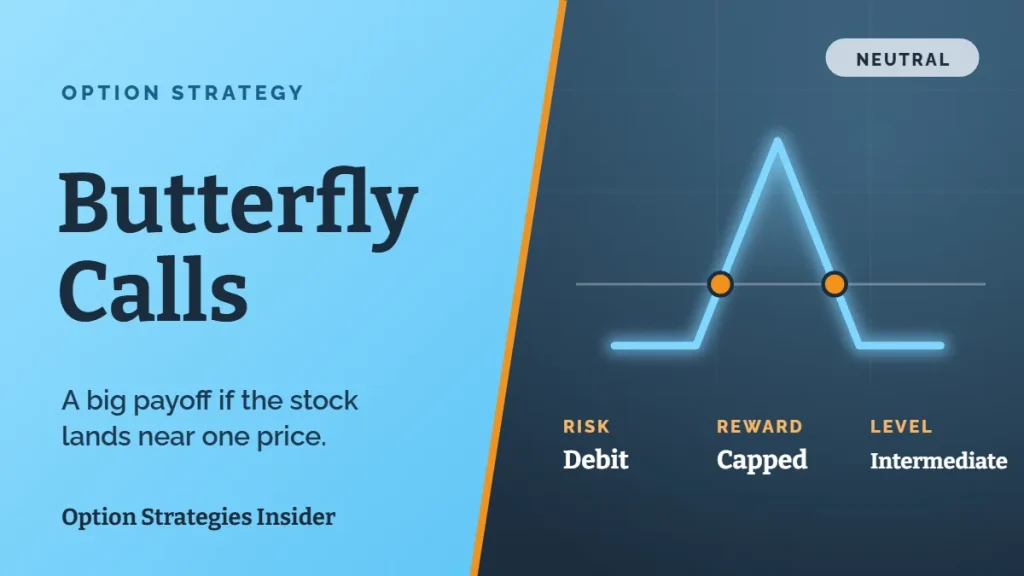
A butterfly spread with calls is a low-cost, defined-risk trade that profits when a stock finishes near a specific price at expiration. You buy one call at a lower strike, sell two calls at a middle strike and buy one call at a higher strike, all with the same expiration. It’s a favorite for traders who expect a stock to stay put.
How the Call Butterfly Spread Works
- Buy 1 call at strike A
- Sell 2 calls at strike B
- Buy 1 call at strike C
The strikes are evenly spaced, and strike B is usually at the money or at your price target. You pay a small debit to open the trade, and that debit is the most you can lose.
Butterfly Spread Diagram
The payoff looks like a tent. It peaks at strike B and slopes down to your max loss below strike A and above strike C.
Max Profit, Max Loss and Breakeven
- Max profit: strike B minus strike A, minus the debit paid. You get it if the stock closes exactly at strike B.
- Max loss: the debit paid.
- Lower breakeven: strike A plus the debit.
- Upper breakeven: strike C minus the debit.
Butterfly Spread Example
XYZ trades at $100 and you expect it to sit near $100 for the next month. You buy the 95 call for $6.50, sell two 100 calls for $3.50 each and buy the 105 call for $1.50. Your net debit is $1.00, or $100. Your breakevens are $96 and $104. At expiration:
- XYZ at $100: the 95 call is worth $5 and the rest expire worthless. You make $4 a share, or $400, four times what you risked.
- XYZ at $102: the 95 call is worth $7 and the two 100 calls cost you $4, so the spread is worth $3. You make $2 a share, or $200.
- XYZ below $95 or above $105: you lose the $100 debit.
Butterfly Option Settlement at Expiration
How a butterfly settles depends on where the stock closes. Options that finish in the money are exercised automatically. If the stock lands below strike A or above strike C, everything either expires worthless or cancels out. If it lands between the strikes, you could end up with long or short shares over the weekend from the legs that finished in the money.
That’s why most traders close butterflies before expiration rather than letting them settle. With cash-settled index options like SPX, there are no shares involved. The spread simply settles to its cash value.
When to Use a Call Butterfly
- You expect the stock to finish near a specific price.
- You want a high reward compared to your risk, and you’re fine with a lower chance of max profit.
- Implied volatility is high and you expect it to fall, which helps the trade.
Butterfly Spread vs. Iron Butterfly
The iron butterfly has the same shape but uses both puts and calls and is opened for a credit instead of a debit. A butterfly spread with puts uses only puts and behaves almost exactly like the call version. If you’re bullish and want a target above the current price, the Christmas tree spread with calls is a close cousin.
Tips for Trading the Call Butterfly
- Center it where you expect the stock to land. The middle strike is your target, so put it at the price you think the stock will finish.
- Use liquid options. Four contracts across three strikes means bid-ask spreads matter. Start at the midpoint and work your order.
- Be patient, then take profits. Butterflies gain most of their value in the final week or two. Many traders close once they’ve doubled their debit instead of waiting for max profit.
- Keep your size small. The risk is limited, but max profit is rare, so spread your bets across several trades.
Common Call Butterfly Mistakes
- Expecting a quick payoff. Most of a butterfly’s profit comes in the last couple of weeks, so give the trade time to work.
- Using illiquid options. Four contracts across three strikes means wide spreads can eat the profit. Stick to liquid stocks and ETFs.
Butterfly Spread FAQ
Is a butterfly spread bullish or bearish?
A butterfly centered at the current price is neutral. You can make it bullish or bearish by centering it above or below the stock price.
Why is it called a butterfly?
The payoff diagram has a body in the middle, the two short options, and wings on each side, the two long options.
What’s the risk of a butterfly spread?
Only the debit you pay. The trade-off is that max profit only happens if the stock closes right at the middle strike, so most butterflies end up somewhere in between.
Conclusion
The call butterfly is a cheap, defined-risk way to profit from a stock landing near your target. It rewards precision, so it works best when you have a clear price in mind and a realistic timeframe.
Related Option Strategies Articles
- Butterfly Spread with Puts Option Strategy
- Iron Butterfly Option Strategy
- Christmas Tree Spread with Calls Option Strategy
- All 28 option strategies every trader should know
Want to learn how to build multi-leg trades like this? Check out our beginner’s options trading course.