Financial Ratios: 5 Types and Key Formulas
Financial ratios turn a company's financial statements into a handful of numbers you can actually compare. Instead of digging through a 100-page annual report, you can quickly see how a
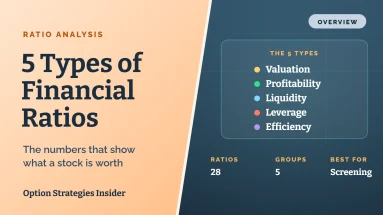
Financial ratios turn a company's financial statements into a few numbers you can compare. Each guide explains the formula, what a healthy range looks like and how investors use it, with simple examples. Start with the 5 types of financial ratios, profit margin, debt-to-equity and return on equity.
Financial ratios turn a company's financial statements into a handful of numbers you can actually compare. Instead of digging through a 100-page annual report, you can quickly see how a

The quick ratio, also commonly referred to as the acid test ratio, is among the financial ratios typically used to assess a business's overall short-term liquidity. It evaluates a company's

Stakeholders hold the key to start a business and make way for its growth. That is why certain tools are employed to help them make decisions that can significantly affect

The receivable turnover ratio or accounts receivable turnover ratio is among of activity ratios used to assess the ability of the business to convert accounts receivable into cash within a

The inventory turnover ratio, also referred to as inventory turns, stock turnover, or stock turns, is an efficiency metric that shows how long a business takes to sell all its

The asset turnover ratio is an essential financial ratio used to understand how effective a company is at using its assets to create revenue. The ratio can be used to

The debt-to-capital ratio is among a group of leverage financial ratios that shows the proportion of debt a company uses to finance its assets, in relation to the amount of

The debt-to-income ratio (DTI) is a tool that relates recurring monthly debt of an individual to their overall gross income. In this case, the gross income is the revenue before

The interest coverage ratio is a financial ratio that assesses a company's ability to pay the interest owed from debts. It is computed by dividing the earnings before interest and