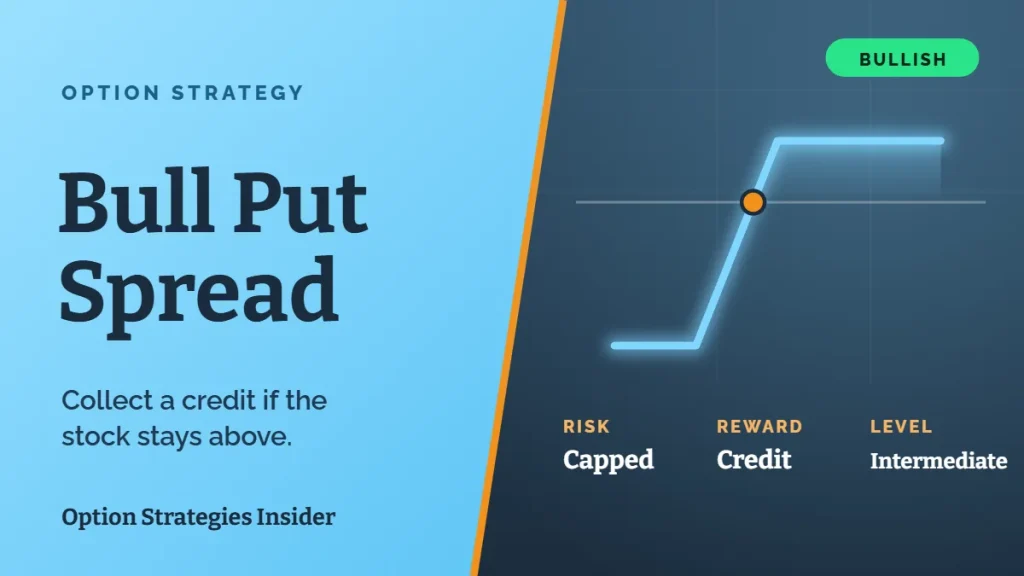
The Bull Put Spread is a vertical spread strategy where the investor sells a higher strike price put option, shown as point B, and buys a lower strike price put option, point A, within the same expiration month. The investor will receive a premium or credit, as the higher strike price put will have more value than the lower strike price put.
The bull put spread is one of the two main credit spreads. If you want the bigger picture first, including how to pick strikes and manage risk, read How Credit Spreads Work.
The investor uses this strategy if they believe the market will stay flat or trade higher. The lower put option is used as a hedge in case the market does trade lower, so the investor can cap their max loss.
Profit/Loss
The most an investor can expect to make on this trade is the credit they received. If the stock finishes above the higher strike price at expiration, the investor will achieve max profit.
The max loss is the difference between the two strike prices minus the premium received. This happens when the stock finishes below the lower strike price at expiration.
Breakeven
The breakeven for a bull put spread is the higher strike price minus the premium received.
Breakeven = short put strike – premium received
Example
A 70-75 bull put spread valued at $2 would consist of selling a 75-strike price put and buying a 70-strike price put. Here the $2 premium would represent the max win if the stock stayed above the 75-strike price. The strikes are $5 apart (70-75), so if the stock finishes below both strikes, the max loss is $5 minus the $2 premium received, or $3.
Time decay is working for the investor if the put spread is out of the money because they want the trade to expire, allowing them to keep the full premium received. Time will be working against the investor if the vertical has both strikes in the money because they would want this trade to continue, giving them more time for the stock to rise in price.
Conclusion
This is a great strategy to use if the investor feels a stock is going higher, but isn’t sure about the timing, or wants to give themselves a cushion in case the market moves sideways or trades down slightly.
Bull Put Spread vs. Bull Call Spread
Both strategies profit from a stock moving higher, but they work in opposite directions. A bull put spread is a credit spread: you collect a premium upfront and keep it if the stock stays above your short strike. A bull call spread is a debit spread: you pay a premium upfront and profit as the stock rises past your long strike. If you want to collect income with time decay working for you, the bull put spread is the better fit. If you would rather pay a known cost upfront and let time decay work against you instead, look at the bull call spread.
Managing a Bull Put Spread If It Gets Tested
If the stock drops toward or through your short put strike before expiration, you have three choices. You can close the spread early for a loss smaller than your max risk, which locks in whatever credit is left. You can roll the spread out to a later expiration, and often down to lower strikes, which brings in an additional credit but extends your exposure. Or you can let it ride to expiration if you still believe in the trade and are fine taking assignment on the stock at the short strike. Which one is right depends on your conviction in the underlying, how much time is left, and whether you actually want to own the stock if assigned.
Bull Put Spread Exit Strategy
Having an exit plan before you enter is what separates consistent credit spread traders from everyone else. Here are the rules many traders use:
- Take profits early. Close the spread once you’ve captured 50% to 75% of the credit. The last bit of premium isn’t worth the risk of a late move.
- Set a max loss. Many traders close if the spread’s value reaches about 2 times the credit received.
- Watch the short strike. If the stock trades through your short put, consider closing or rolling the spread down and out for a credit.
- Close before expiration. If the stock is near your strikes on expiration day, closing avoids the risk of being assigned on just one leg.
FAQ
Is a bull put spread the same as a put credit spread?
Yes. Bull put spread and put credit spread describe the same trade: selling a higher strike put and buying a lower strike put for a net credit.
What is the maximum loss on a bull put spread?
Your max loss is the width between the two strikes minus the credit received, multiplied by 100 per contract. Sell a 75 put and buy a 70 put for a $2 credit, and your max loss is $3 per share, or $300 per contract.
Can a bull put spread lose more than the credit received?
No. The long put you buy caps your downside, so the most you can lose is the strike width minus the credit, not the full value of the stock. That is what separates it from selling a naked put.
The bull put spread is one of two directional credit spreads. If you are bearish or expect a stock to stay flat or fall, the bear call spread works the same way in the opposite direction.
Related Option Strategies Articles
- How Credit Spreads Work
- Bear Call Spread Option Strategy
- Short Put Option Strategy
- All 28 option strategies every trader should know
The bull put spread is one of our favorite credit spreads. To learn how we pick strikes and manage these trades, take our beginner options trading course.