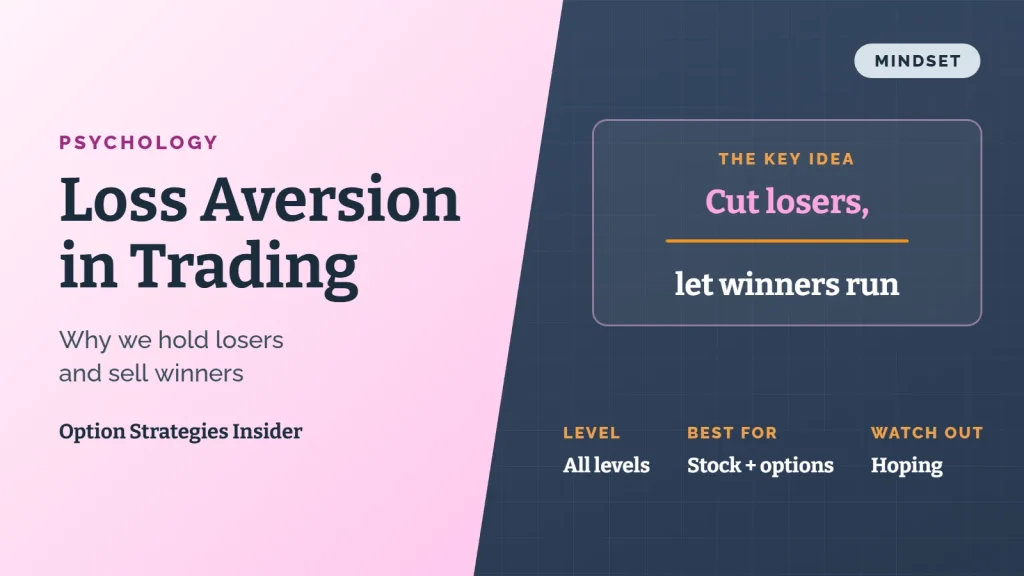
Loss aversion is the tendency to feel the pain of a loss more strongly than the pleasure of an equal gain. In trading, it shows up in a very specific and costly way: we hold losing positions too long, hoping they come back, and we sell winning positions too early to lock in a profit.
Researchers call this pattern the disposition effect, and it is one of the best documented habits in investing. The good news is that once you know what it looks like, a few simple rules can keep it from running your account.
What the Research Shows
Psychologists Daniel Kahneman and Amos Tversky described loss aversion as part of prospect theory, the work that later earned Kahneman a Nobel Prize. In their 1992 study, they estimated that a loss carries about 2.25 times the emotional weight of a gain of the same size. A 2024 review of 150 studies found an average closer to 2 times. In plain terms, losing $1,000 feels about as bad as winning $2,000 feels good.
Economists Hersh Shefrin and Meir Statman named the trading version of this the disposition effect in 1985. Then in 1998, Terrance Odean studied the records of 10,000 accounts at a large discount broker and found that investors sold their winning stocks far more readily than their losers. Across the full data set, investors realized about 14.8% of the gains available to them, but only about 9.8% of their losses.
Worse, the winners investors chose to sell went on to outperform the losers they kept. In other words, people were consistently selling the wrong positions.
How Loss Aversion Shows Up in Your Trades
Holding losers and hoping
Closing a losing trade makes the loss real. As long as the position is open, it still feels like it might come back. So traders move their stop, skip their stop or simply stop looking at the position.
Cutting winners short
A gain feels good, and there is a strong urge to lock it in before it disappears. That leads to taking small profits on good trades while letting bad trades run, which is the opposite of what most profitable strategies need.
Averaging down without a plan
Adding to a losing position to lower your average cost can make the loss feel smaller on paper. Sometimes it is a planned strategy. Often it is just a way to avoid admitting the original trade was wrong. If you do add to positions, do it with a plan, as we explain in our guide to scaling in.
Loss Aversion in Options Trading
Options traders have a few versions of this bias all their own:
- Holding long options into expiration. A call that is down 60% feels cheap to hold “just in case.” But time decay speeds up near expiration, and many of these positions go to zero.
- Rolling losers forever. Rolling a short option out to a later date can be a smart adjustment. Rolling the same losing position month after month, often for less credit each time, is usually just a way to avoid booking the loss.
- Taking profits too early on spreads. Closing a credit spread at a small profit can be a good rule. Closing it because you are nervous, and then letting your losing spreads run to max loss, flips your risk and reward upside down.
- Refusing to sell a stock with a covered call. Some traders avoid selling a covered call on a stock that is underwater because the strike would lock in a loss if the shares get called away, even when the trade makes sense.
How to Manage Loss Aversion
1. Decide your exit before you enter
Before you place a trade, write down your stop and your target. Decisions made before money is on the line are far more rational than decisions made while you are watching a loss grow. Then follow the plan, especially when you do not want to.
2. Use rules, not feelings, for taking profits
Set clear profit rules, such as closing credit spreads at 50% of max profit or trailing a stop on a winning stock. When the rule decides, you stop selling winners just because they feel good.
3. Ask the fresh money question
Look at each open position and ask: “If I had cash instead of this position, would I buy it today at this price?” If the answer is no, the only reason you are holding it is that selling would make the loss real. That is loss aversion talking.
4. Size positions so a loss is easy to take
Loss aversion gets stronger as the dollar amount grows. If a single loss would really hurt, the position is too big. Smaller size makes it much easier to follow your stop.
5. Define your risk up front
Strategies with a known max loss, like debit spreads and credit spreads, remove some of the decision making from a losing trade. Stock traders can do something similar with a protective put, which caps the downside for a set cost.
6. Review your trades by process, not just results
In your trading journal, track whether you followed your exit rules on every trade. Over time, look at how your average loss compares with your average win. If your losses are bigger than your wins, loss aversion is likely part of the reason.
A Simple Example
Say you have two trades open. Trade A is up $500. Trade B is down $500. You need cash for a new idea, so you have to close one.
Most people close Trade A. It feels good to bank a win, and closing Trade B would mean admitting a loss. But the better question is which position has the stronger outlook from here. If Trade B’s reason for being in the trade is broken, it should go first, no matter how it feels.
The Bottom Line
Loss aversion is wired into how people think, so you will never fully get rid of it. What you can do is build rules that make the right decision automatic: exits set in advance, sizes you can live with and regular reviews of how you actually trade.
The traders who do well over time are not the ones who never lose. They are the ones who keep their losses small and let their winners do the heavy lifting. For more on the habits that make that possible, read 5 qualities of successful options traders, and see our guide to revenge trading for what happens when a loss turns into a rushed next trade.
Frequently Asked Questions
What is the difference between loss aversion and the disposition effect?
Loss aversion is the general tendency to feel losses more than gains. The disposition effect is how that tendency shows up in investing: selling winners too early and holding losers too long.
Is holding a losing position ever the right call?
Yes, if your original reason for the trade still holds and the position is within your planned risk. The problem is holding only because selling would make the loss real.
How can options help with loss aversion?
Defined risk strategies like spreads, and hedges like protective puts, set your maximum loss before you enter. That takes some of the hardest decisions off the table when a trade moves against you.