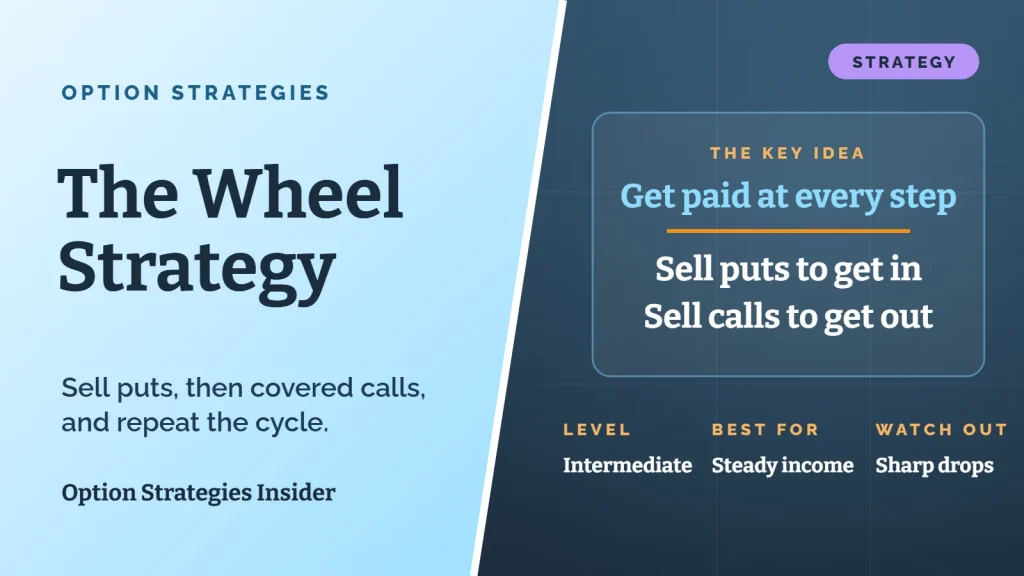
The wheel strategy is an options income strategy that cycles between two trades: you sell cash-secured puts until you’re assigned shares, then sell covered calls on those shares until they’re called away, and start over. It isn’t a separate strategy so much as two strategies from our list of 28 option strategies run back to back. The appeal is simple: you collect premium at every step, whether the stock goes up, down or sideways.
It’s popular because it turns two of the most beginner-friendly option trades into a repeatable process. But it isn’t free money. You’re getting paid to take on the same downside risk as owning the stock, so it only works on stocks you’d be happy to hold through a rough patch.
How the Wheel Strategy Works
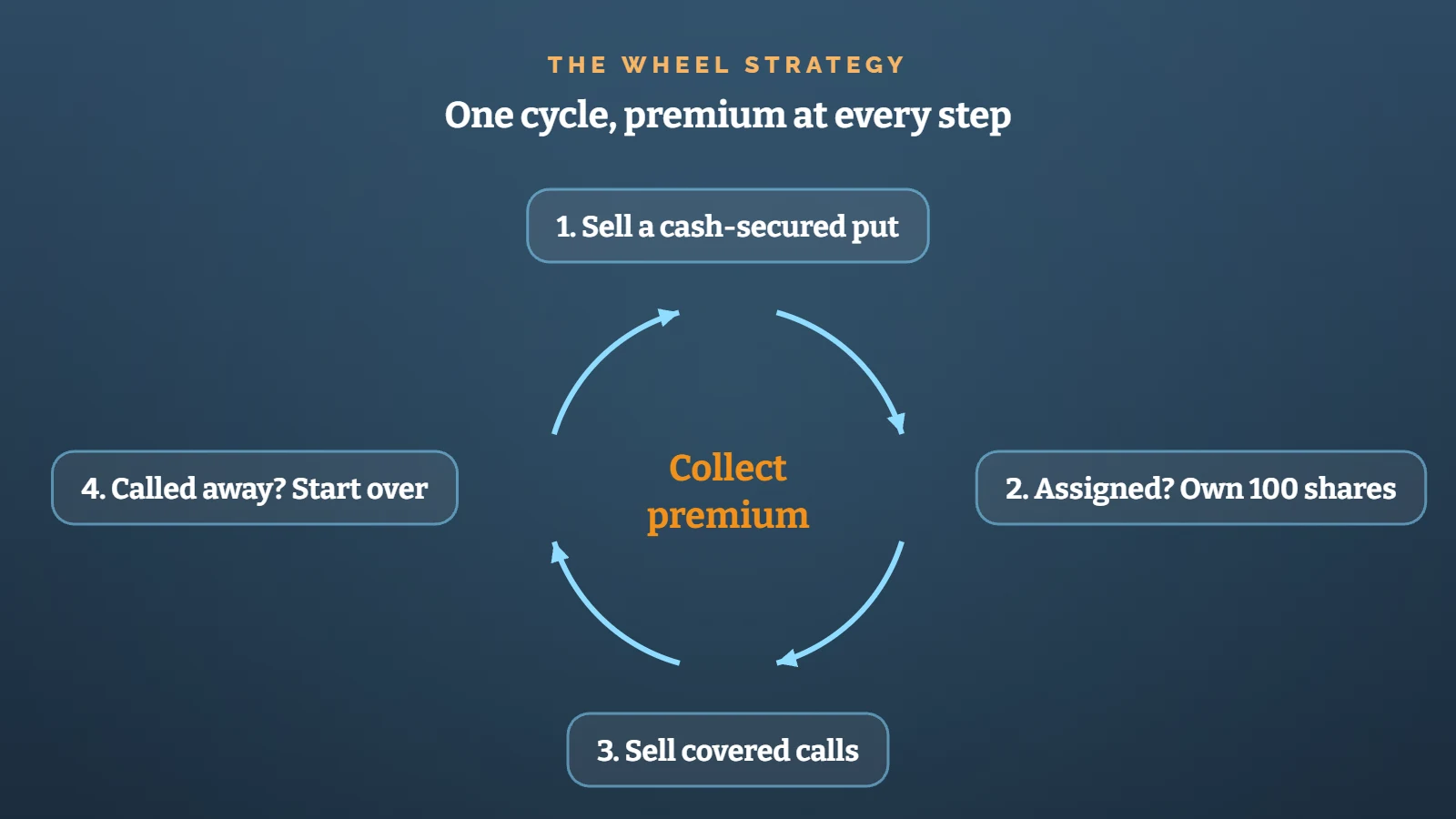
The wheel runs in three steps that repeat:
- Sell a cash-secured put. Pick a stock you like and sell a put below the current price, keeping enough cash set aside to buy 100 shares at the strike. You collect the premium up front.
- If the put expires worthless, sell another one. The stock stayed above your strike, so you keep the full premium and repeat step 1. If the stock closes below the strike, you’re assigned and buy 100 shares at the strike price.
- Sell covered calls on the shares. Now that you own the stock, sell a call above your cost. If the stock rallies past the strike, your shares get called away at a profit and you go back to step 1. If not, you keep the premium and sell another call.
That’s the whole wheel: puts until you own it, calls until you don’t, and premium coming in the entire time.
A Worked Example
Here’s how the math works with round numbers. Say stock XYZ trades at $50 and you’d be happy to own it a little lower.
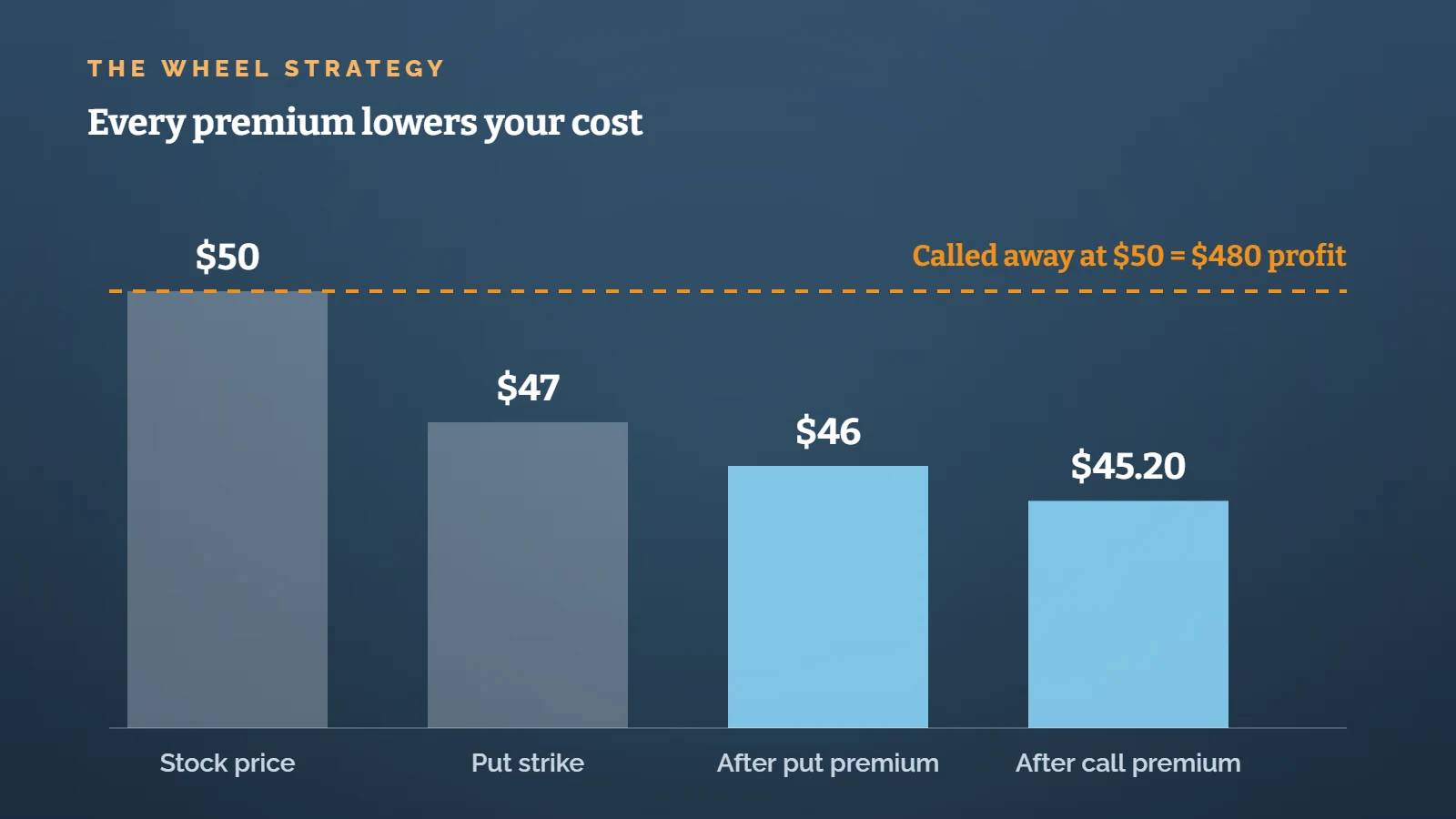
- Step 1: You sell one 30-day $47 put for $1.00, collecting $100. You set aside $4,700 in cash in case you’re assigned.
- If XYZ stays above $47: the put expires worthless and you keep the $100, about 2.1% on the cash you set aside, then sell another put.
- If XYZ drops below $47: you buy 100 shares at $47. Because you already collected $1.00, your real cost is $46 a share.
- Step 3: You sell a 30-day $50 call for $0.80, collecting $80 more. Your cost basis drops to $45.20.
- If XYZ rallies above $50: your shares are called away at $50. You made $300 on the stock, plus $100 from the put and $80 from the call, for $480 total.
- If XYZ stays below $50: you keep the $80 and the shares, and sell another call.
Notice that every premium you collect lowers your break-even point. That’s the real engine of the wheel: it doesn’t make a stock go up, but it keeps chipping away at your cost while you wait.
How to Pick a Stock for the Wheel
The stock matters more than the strikes. The wheel works best on:
- Companies you’d be happy to own. Assignment isn’t a failure, it’s part of the plan. If you’d panic owning the shares, don’t sell puts on them.
- Liquid options. Tight bid-ask spreads and plenty of open interest, so you’re not giving up premium just getting in and out.
- Stocks that trade sideways or grind higher. Steady names let you keep collecting premium. Stocks that make big jumps either way tend to blow through your strikes.
- A share price your account can handle. One contract means 100 shares, so a $50 stock ties up about $5,000 in cash.
Choosing Strikes and Expirations
Most wheel traders sell options 30 to 45 days out, where time decay works fastest without forcing you to trade every week. For the puts, a strike around 0.20 to 0.30 delta gives you a decent premium with a reasonable cushion below the current price.
For the covered calls, the key rule is to sell strikes at or above your cost basis. If you sell a call below what you paid, a rally can lock in a loss on the shares. It’s better to collect a smaller premium than to get called away under water.
Premiums are bigger when implied volatility is high, but high volatility usually means the market sees more risk. Be wary of selling puts right before earnings, when a single report can gap the stock well past your strike.
The Risks of the Wheel Strategy
- A big drop still hurts. If the stock falls from $50 to $35, the premiums you collected only soften the loss. You carry nearly the same downside as owning the shares.
- Your upside is capped. Once you sell a covered call, a big rally above the strike goes to the buyer, not you.
- It ties up a lot of cash. Each cash-secured put needs enough money to buy 100 shares, which limits how many positions you can run.
- You can get stuck. If the stock falls well below your cost, calls above your basis may pay very little, and you could be holding shares for months.
Wheel Strategy vs. Covered Calls vs. Cash-Secured Puts
A covered call alone works if you already own the stock and just want income on it. A cash-secured put alone works if you want to buy a stock at a lower price and get paid to wait. The wheel simply connects the two, so you always have a next step no matter what the stock does. If you’d rather cap your risk on the put side, you can run a similar income approach with credit spreads, which need far less capital but never put shares in your account.
Common Wheel Strategy Mistakes
- Wheeling a stock just because the premium is high, without wanting to own it.
- Selling covered calls below your cost basis and locking in a loss.
- Putting too much of your account in one wheel. A single bad stock can wipe out months of premium.
- Ignoring earnings dates and getting caught on the wrong side of a gap.
Wheel Strategy FAQ
Is the wheel strategy profitable?
It can be, but it isn’t guaranteed. You collect steady premium, and the strategy does best when the stock trades sideways or slowly higher. A sharp drop in the stock can wipe out many months of premium, so stock selection and position size matter most.
How much money do you need for the wheel strategy?
Enough to buy 100 shares of the stock at your put strike. A $20 stock needs about $2,000 per contract, while a $150 stock needs about $15,000.
What happens if the stock drops a lot?
You’re assigned and own the shares at your strike, with the premium lowering your cost. From there you can keep selling covered calls at or above your cost basis and wait for a recovery, or sell the shares and take the loss if your view on the company has changed.
Can you run the wheel on ETFs?
Yes. Many traders prefer broad ETFs for the wheel because they’re less likely to gap on one company’s news, though the premiums are usually smaller than on individual stocks.
This article is for educational purposes only and is not investment advice. Always do your own research before making any investment decision.
Related Option Strategies Articles
- Short Put Option Strategy
- Covered Call Option Strategy
- How Credit Spreads Work
- All 28 option strategies every trader should know
Ready to trade puts and covered calls with a plan behind them? Our free beginner options trading course walks through both, step by step.