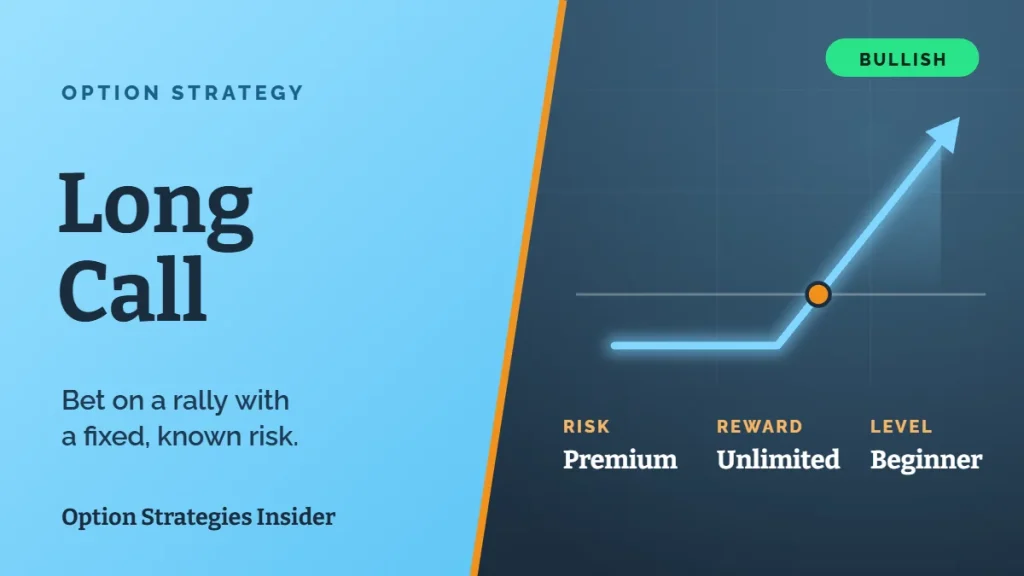
A long call is the most basic bullish options trade. You buy a call option, which gives you the right to buy 100 shares at the strike price before expiration. If the stock rises above the strike, the call gains value. If it doesn’t, the most you can lose is what you paid.
It’s a way to profit from a stock going up while risking much less money than buying the shares outright.
How a Long Call Option Works
When you buy a call, you pay a premium to the seller. In return, you own the right, but not the obligation, to buy the stock at the strike price. You can sell the call for a profit if it rises in value, exercise it to buy the shares, or let it expire.
Long Call Diagram
The diagram is flat below the strike at your max loss, the premium paid. Above the strike, it rises dollar for dollar with the stock, crossing zero at your breakeven.
Max Profit, Max Loss and Breakeven
- Max profit: unlimited, since there’s no limit to how high a stock can go.
- Max loss: the premium paid.
- Breakeven: the strike price plus the premium paid.
Long Call Example
XYZ trades at $100 and you think it’s headed higher over the next two months. You buy the 105 call for $2.50, which costs $250. Your breakeven is $107.50. At expiration:
- XYZ rallies to $120: the call is worth $15. You make $12.50 a share, or $1,250, a 500% return on your $250.
- XYZ closes at $107.50: the call is worth $2.50, so you break even.
- XYZ stays at or below $105: the call expires worthless and you lose the $250.
Buying 100 shares instead would cost $10,000. The call gives you a similar upside for a fraction of the cost, but it can expire worthless if the stock doesn’t move in time.
How to Pick a Strike and Expiration
- In the money calls cost more but act more like the stock and have a better chance of paying off. Learn more about in the money vs. out of the money options.
- Out of the money calls are cheaper and pay more on a big move, but they’re more likely to expire worthless.
- Give yourself time. Calls lose value every day through time decay, so buying a little more time than you think you need is usually worth it.
Long Call vs. Buying the Stock
Buying 100 shares gives you every dollar of the move with no expiration date, but it ties up a lot of cash and exposes you to the full drop if the stock falls. A long call costs far less and caps your loss at the premium, but it has a deadline. If the stock rises after your call expires, you don’t benefit. Calls are best when you expect a move within a specific timeframe.
Common Long Call Mistakes
- Buying too little time. Short-dated calls are cheap for a reason. The stock has to move fast.
- Buying when implied volatility is high. You can be right on direction and still lose money if IV drops after earnings or news.
- Going too far out of the money. Lottery-ticket calls rarely pay off. A strike closer to the stock price gives you a better chance.
- Risking too much. Since calls can go to zero, only put in what you can afford to lose on each trade.
Long Call vs. Bull Call Spread
If calls look expensive, a bull call spread lowers your cost by selling a higher strike call against the one you buy. You cap your upside, but your breakeven moves closer and your risk drops. That’s often a better choice when implied volatility is high.
Long Call FAQ
Can I lose more than I paid for a call?
No. The most you can lose on a long call is the premium you paid.
Do I have to exercise my call?
No. Most traders simply sell the call before expiration to lock in a profit, which is easier than exercising and buying 100 shares.
When should I sell my long call?
Many traders take profits once the stock hits their target or the call doubles in value, rather than holding to expiration as time decay speeds up.
How much money do I need to buy a call option?
Just the premium, plus any commission. A call quoted at $2.50 costs $250 for one contract, since each contract covers 100 shares. That’s why calls are popular with smaller accounts: you get exposure to 100 shares for a fraction of what the stock itself would cost.
Conclusion
The long call lets you bet on a rising stock with limited risk and big upside. Pick a realistic strike, give the trade enough time and have a plan for taking profits.
Related Option Strategies Articles
- Long Put Option Strategy
- Bull Call Spread Option Strategy
- Understanding Option Delta
- All 28 option strategies every trader should know
To learn how to pick the right calls for your trades, check out our free online options trading course.