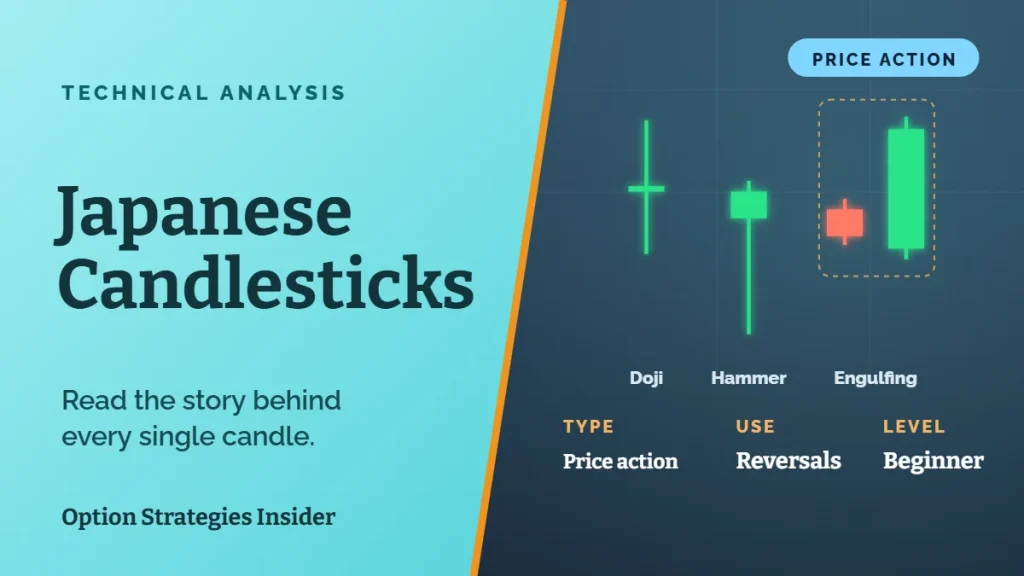
Japanese candlestick charts are one of the most popular ways to read a stock chart, and learning a handful of Japanese candlestick patterns is one of the fastest ways to read what buyers and sellers are doing. Each candle packs four prices into one simple shape: the open, the high, the low and the close for that period. Once you know how to read them, a quick glance tells you whether buyers or sellers are in control, and whether that control is starting to shift.
Candlesticks were developed in Japan in the 1700s, where rice traders used them to track prices and market sentiment. Today they’re the default chart on nearly every trading platform, whether you trade stocks, options, futures or forex.
The Anatomy of a Candlestick
Each candle has two parts. The thick part is the body, which shows the distance between the opening and closing price. The thin lines above and below are the wicks, also called shadows, which mark the high and low for the period.
- Long body: strong buying or selling pressure.
- Short body: indecision, with little difference between the open and close.
- Long upper wick: buyers pushed price up, but sellers drove it back down before the close.
- Long lower wick: sellers pushed price down, but buyers stepped in and drove it back up.
Long wicks show a real tug-of-war between buyers and sellers, and they often appear near turning points. Short wicks suggest the current trend has room to continue.
Bullish Candles
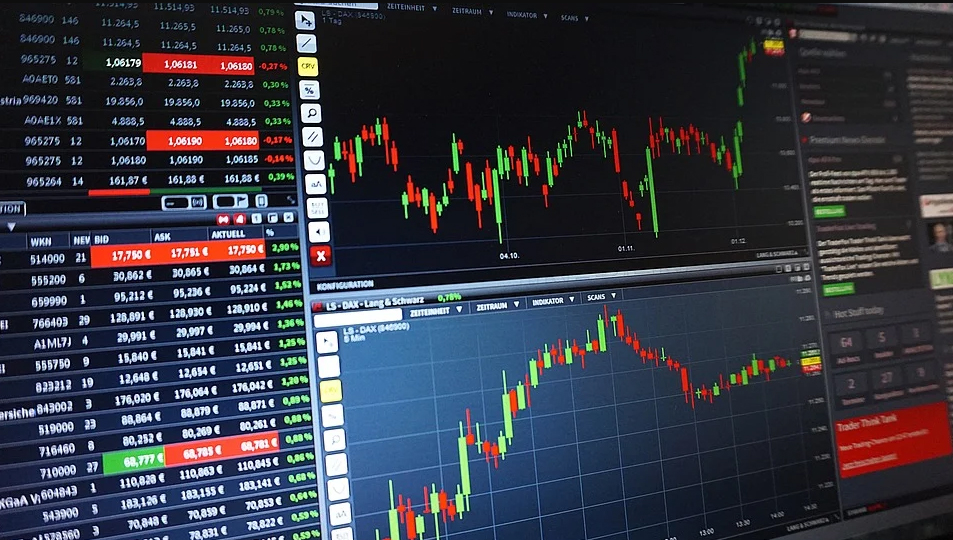
A bullish candle forms when the stock closes higher than it opened. It’s usually shown in green or white. The open sits at the bottom of the body and the close at the top, so a long green body tells you buyers were in control for the whole session.
One of the most reliable bullish signals is the bullish engulfing pattern, where a large green candle completely covers the previous red candle’s body after a decline. It shows buyers taking over from sellers.
Bearish Candles
A bearish candle forms when the stock closes lower than it opened, and it’s usually shown in red or black. The open is at the top of the body and the close at the bottom. The longer the red body, the stronger the selling pressure, and a string of long red candles often signals a downtrend.
5 Candlestick Patterns Every Trader Should Know
- Doji: the open and close are almost the same, leaving a tiny body. It signals indecision and often shows up before a reversal.
- Hammer: a small body near the top with a long lower wick, appearing after a decline. Sellers pushed price down, but buyers fought back.
- Shooting star: the opposite of a hammer. A small body near the bottom with a long upper wick after a rally, warning that buyers are losing steam.
- Engulfing patterns: a large candle whose body fully covers the prior candle’s body. Bullish after a decline, bearish after a rally.
- Morning and evening star: three-candle reversal patterns. A morning star marks a potential bottom, and an evening star marks a potential top.
How to Use Candlesticks With Trend and Support
A single candle is rarely enough to trade on. Candlestick signals work best when they line up with the bigger picture. A hammer at a key support level in an uptrend means much more than a hammer in the middle of nowhere. Look at the overall trend first, mark your support and resistance levels, then use candlesticks to time your entries and exits.
Volume helps too. A reversal candle on heavy volume shows real conviction, while the same candle on light volume is easier to fake. Pairing candlesticks with an indicator like the RSI can also confirm whether momentum is backing up the signal. For bigger chart patterns, see our guide to 17 stock chart patterns.
Common Candlestick Mistakes
- Trading every signal. Patterns show up all the time. Only act on the ones that form at important levels and agree with the trend.
- Ignoring the time frame. A hammer on a 5-minute chart carries far less weight than one on a weekly chart.
- Not waiting for confirmation. Many traders wait for the next candle to close in the expected direction before entering, which filters out a lot of false signals.
- Skipping the stop. Every candlestick trade needs an exit plan. A common approach is placing a stop just beyond the wick of the signal candle.
Candlesticks and Supply and Demand
At their core, candlesticks are a picture of supply and demand. When demand from buyers outweighs supply from sellers, you get green candles and rising prices. When sellers overwhelm buyers, red candles take over. Reading candles is really just reading that battle in real time, which is why they work in any market.
Candlesticks show you what buyers and sellers are doing right now. To learn how to act on those signals with options, check out our free options trading course.