
Butterfly Spread Calculator
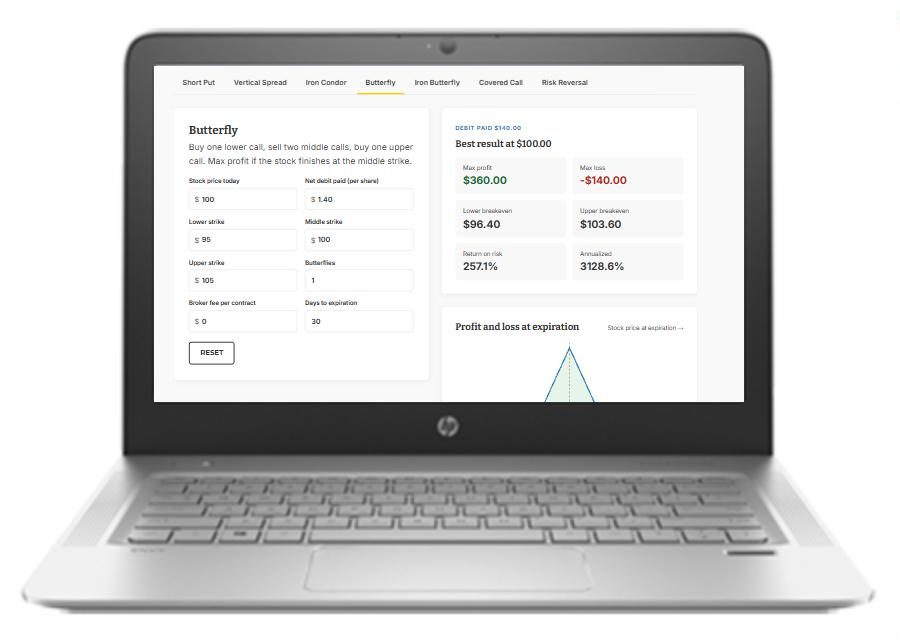
Free butterfly spread calculator for call and put butterflies. Enter your three strikes and the debit to see max profit, max loss, both breakevens and a profit and loss chart.
Free account
Want to see how we trade these strategies?
Our members get every trade we place, with the entry, the reasoning and the exit plan. Start with a free account and learn the strategies behind these calculators.
✓ Free beginner and intermediate options training
✓ Lessons on spreads, condors and butterflies
✓ Upgrade anytime for every trade we place
Join free in under a minute
No credit card required.
Upgrade only if you want trade alerts.
How the Butterfly Spread Calculator Works
A butterfly is a low-cost way to target a specific price. Here's how the trade works and how the calculator figures your numbers.
What Is a Butterfly Spread?
A long butterfly buys one option at a lower strike, sells two at a middle strike and buys one at a higher strike, all with the same expiration. You pay a small debit, and the trade makes the most if the stock finishes right at the middle strike. You can build it with calls or puts, and with evenly spaced strikes the payoff is the same either way.
How the Calculator Figures Your Numbers
Max loss is the debit you pay. Max profit is the distance between strikes minus the debit, reached if the stock finishes at the middle strike. The lower breakeven is the lower strike plus the debit, and the upper breakeven is the upper strike minus the debit.
Butterfly Spread Example
Say a stock is at $100 and you buy the $95/$100/$105 call butterfly for a $1.40 debit. Your max loss is $140. Your max profit is $360 if the stock finishes at $100, and your breakevens are $96.40 and $103.60.
Butterfly Spread FAQ
Should I use calls or puts for a butterfly?
With evenly spaced strikes, a call butterfly and a put butterfly have the same payoff at expiration. Traders usually pick whichever has better prices and tighter bid-ask spreads. The calculator works for both.
Why is the max profit so much bigger than the cost?
Because you only get it if the stock finishes right at the middle strike, which doesn't happen often. Most of the time you'll close a butterfly early for a partial gain or a small loss. The return on risk looks big because the odds of the full payout are low.
When does a butterfly make sense?
When you expect the stock to land near a specific price by expiration, for example after earnings or near a level it keeps returning to. It's a cheap way to target that price with a small, defined risk.
How is a butterfly different from an iron butterfly?
A long butterfly uses all calls or all puts and costs a debit. An iron butterfly mixes puts and calls and pays you a credit. With the same strikes, their payoffs have the same shape.
More Free Options Calculators
Want to learn the strategy in depth? Read our Butterfly Spread with Calls Option Strategy guide.
Try another free calculator: Short Put Calculator, Vertical Spread Calculator, Iron Condor Calculator, Iron Butterfly Calculator, Covered Call Calculator or Risk Reversal Calculator. You can also see all options calculators in one place.
Calculations are at expiration, include the broker fee you enter, and are for education only. Margin figures are estimates and vary by broker.
Company
About
Options Trading


If you don’t agree with (or cannot comply with) our Terms of Service or policies, then you may not use this site and must exit immediately. Please be advised that your continued use of this site and information within shall indicate your consent and agreement to these terms and conditions.
Option Strategies Insider may express or utilize testimonials or descriptions of past performance, but such items are not indicative of future results or performance, or any representation, warranty or guaranty that any result will be obtained by you. These results and performances are NOT TYPICAL, and you should not expect to achieve the same or similar results or performance. Your results may differ materially from those expressed or utilized by Option Strategies insider due to a number of factors.